
Is One Day in Osaka Enough? A Local Guide’s Honest Answer

For most first-time visitors, one full day is enough to see Osaka’s main sightseeing highlights.
You can explore Dotonbori and Namba, try local food, visit Shinsekai, and add Osaka Castle if history is one of your priorities.
I have spent years guiding international visitors around Osaka, and my honest opinion is that most travelers do not need two or three full days simply to visit the city’s major attractions.
However, sightseeing is not the only reason to stay.
Osaka’s real appeal comes from its food, nightlife, street culture and human atmosphere. If those are important to you, the city may be worth more than one day.
You can see Osaka in one day. Experiencing Osaka may take longer.
This answer does not include Universal Studios Japan, which normally requires a separate day.
Quick Answer: How Many Days Do You Need in Osaka?
The right amount of time depends on what you want from the city.
Time in Osaka | What it realistically allows |
Half a day | Namba, Dotonbori and part of Minami |
One full day | Minami, Shinsekai and either Osaka Castle or deeper neighborhood exploration |
Two days | Main sights at a relaxed pace, plus shopping, museums, nightlife or local areas |
Three days or more | Universal Studios Japan, deeper exploration and day trips |
For most travelers visiting Osaka as part of a wider Kansai itinerary, one full day offers the best balance.
You can cover the city’s main sightseeing areas without using several days that could also be spent in Kyoto, Nara or other destinations.
That does not mean Osaka is only worth one day. It means that the major attractions are relatively concentrated and easy to combine.
Why One Day Can Be Enough for Osaka Sightseeing
Central Osaka is more compact than many first-time visitors expect.
The city is often divided into two major central areas:
Kita, centered around Umeda
Minami, centered around Namba and Shinsaibashi
Osaka Castle lies to the east of the central districts, while Shinsekai is farther south.
These areas are connected by trains and subways, and many of the most distinctive neighborhoods around Minami are close enough to explore on foot.
Umeda is an important business, transport and shopping district. It has major department stores, underground shopping areas, restaurants and modern landmarks.
However, if this is your first visit and you have only one day, I would spend more time in Minami.
Minami gives visitors a more immediate introduction to the food, street culture, signs, entertainment and visual energy that many people associate with Osaka.
Osaka Is a City of Merchants
Osaka is often described as a city of merchants.
Toyotomi Hideyoshi helped establish Osaka as a major political and commercial center, and the city developed further as a hub of trade and distribution during the Edo period.
This history helped Osaka become known as “the Nation’s Kitchen.”
Unlike Kyoto, where temples, shrines and historic streets dominate many itineraries, Osaka’s identity is more closely connected to commerce, food, entertainment and everyday urban life.
You can still feel that history in its markets, shopping arcades, restaurant districts, oversized signs and businesses competing for attention.
Osaka certainly has important historic landmarks, temples and shrines.
But the city itself is often more interesting than any single monument.
The experience comes from watching people shop, eat, work, drink, advertise, joke and interact.
That human energy is one of the main reasons Osaka feels different from other Japanese cities.
What Makes Osaka Different from Kyoto?
Travelers often compare Osaka with Kyoto because the two cities are close together.
However, they offer very different experiences.
Kyoto rewards slow sightseeing, quiet mornings, historic streets, temples, gardens and traditional architecture.
Osaka becomes more distinctive through food, nightlife, commercial streets and the atmosphere created by the people who live there.
If your Kansai itinerary is short, I would usually devote more daytime sightseeing hours to Kyoto and use Osaka for food, street life and the evening.
That does not make one city better than the other.
During tours, I sometimes ask guests whether they prefer Kyoto or Osaka. The answers are often divided.
Travelers who value quiet surroundings, temples and a more traditional image of Japan often prefer Kyoto.
People who enjoy food, nightlife, casual interactions and lively streets often prefer Osaka.
In my experience as a guide, visitors frequently find people in Osaka more willing to joke, begin casual conversations or offer recommendations than they expected.
For some travelers, that friendliness becomes more memorable than any individual sightseeing attraction.
What Should You Prioritize in One Day?
There is no need to force every famous Osaka attraction into one day.
A better approach is to choose between two styles of itinerary.
Option 1: Osaka Castle, Minami and Shinsekai
Choose this route if you want a balanced introduction to Osaka’s history, food and street culture.
Start at Osaka Castle Park in the morning.
Osaka Castle is the city’s best-known historic landmark, although the current tower is a modern reconstruction. The site is still important for understanding Toyotomi Hideyoshi and Osaka’s place in Japanese history.

After visiting the park, continue to Minami for Dotonbori, Namba and the surrounding neighborhoods.
Finish the day in Shinsekai, where you can experience a more retro and working-class side of Osaka.
This route gives you a broad overview, but it can feel busy. You should not expect to spend a long time at every stop.
Option 2: Skip Osaka Castle and Focus on Street Life
Osaka Castle is not essential for every traveler.
If you are more interested in food, street culture, shopping and nightlife than history, skip the castle and spend the full day around Minami and Shinsekai.
Begin in Amerikamura, cross into Horie, follow the Dotonbori River toward Namba, and continue through Dotonbori and Hozenji Yokocho.
Depending on your pace and interests, you can also visit Kuromon Market, Den Den Town or Sennichimae Doguyasuji.
You do not need to visit all three.
This option gives you more time to eat, stop for photographs, enter shops and experience the atmosphere without rushing.
For many first-time visitors, this is the more enjoyable Osaka itinerary.
What to See in Minami
If you have limited time, prioritize Minami.
The neighborhoods are close together, but each has a different character.
Amerikamura and Horie
Amerikamura, often called Ame-Mura, is associated with youth culture, street fashion, vintage clothing and music.
Just across Yotsubashi Street is Horie.
Horie has fashionable cafés, boutiques, furniture stores and a calmer atmosphere.
What makes this area interesting is how quickly the environment changes.
Within a few minutes, you can move between two neighborhoods with very different personalities.

That contrast is easy to miss if you only travel between major attractions by train.
Dotonbori and Hozenji Yokocho
From Amerikamura and Horie, walk toward the Dotonbori River and continue to the famous Glico sign.
Dotonbori is crowded, commercial and deliberately excessive.
Restaurants use enormous three-dimensional signs shaped like crabs, octopuses, dragons and other characters to attract attention.
These signs are more than tourist decorations.
They are a visual expression of Osaka’s merchant culture, with every business trying to stand out from the competition.

Only a short walk away is Hozenji Yokocho.
Its narrow stone-paved alley and smaller restaurants provide an immediate contrast with Dotonbori’s neon signs and crowds.

This sudden change in atmosphere is one of the most enjoyable parts of exploring Minami on foot.
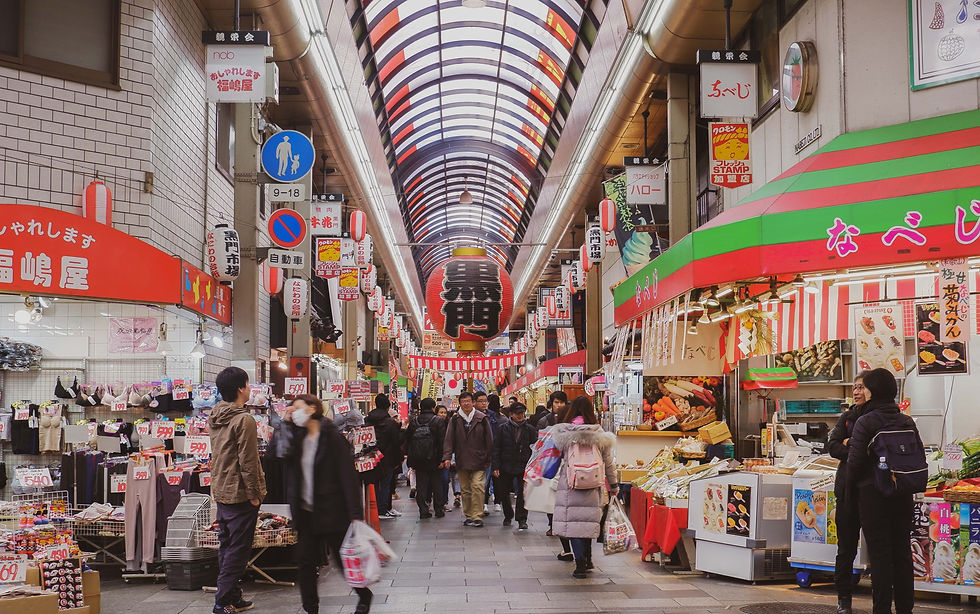
Kuromon Market
Kuromon Market is now much more visitor-oriented than it once was, and some prices can be higher than expected.
It can still be an interesting stop if it fits naturally into your route.
You can see seafood, fruit, meat, snacks and Japanese ingredients in one concentrated area.

However, I would not treat Kuromon Market as essential or as the only place to experience Osaka’s food culture.
Visit it as part of a wider walk through Minami rather than making it the main purpose of your day.
Den Den Town and Doguyasuji
Nipponbashi Den Den Town is Osaka’s major electronics and pop-culture district.
It has shops selling anime goods, figures, games, electronics, model kits and collectibles.
Nearby, Sennichimae Doguyasuji is dedicated to kitchen tools and restaurant equipment.
Its stores sell knives, cookware, tableware, professional kitchen equipment, restaurant signs and plastic food samples.
Doguyasuji offers a different way to understand Osaka’s food culture.
Instead of simply eating local dishes, you can see the tools and businesses that support the city’s restaurant industry.
These neighborhoods are easy to reach, but their cultural differences are not always obvious to first-time visitors.
Our Osaka Free Walking Tour connects the major areas of Minami and explains how Osaka’s food, commerce, youth culture and entertainment developed side by side.
Finish the Day in Shinsekai

Shinsekai is especially atmospheric from late afternoon into the evening.
The area is known for Tsutenkaku Tower, kushikatsu restaurants, retro game arcades and the atmosphere of older working-class Osaka.
It has become cleaner and more visitor-friendly over the years, but it still feels very different from the polished shopping districts around Umeda.
Bright signs, casual restaurants and narrow streets create a slightly chaotic atmosphere that many visitors find unmistakably Osakan.
Shinsekai also lies near neighborhoods with complex social histories, including Nishinari.
These areas reveal a side of Osaka that is often missing from standard sightseeing itineraries.
Visitors should explore respectfully, especially around residential streets and places where photography could be intrusive.
Travelers interested in Shinsekai and the less visible history of southern Osaka can explore the area on our Osaka Night Walking Tour.
Should You Stay Overnight in Osaka?
You do not necessarily need to stay overnight in Osaka purely for sightseeing.
Kyoto and Osaka are well connected, so many travelers can choose one city as a base instead of changing hotels between them.
Moving hotels often takes more time than expected.
You need to pack, check out, transport or store your luggage, travel to the next hotel and check in again.
For a short Kansai trip, that process may not be worth the effort.
However, staying in Osaka makes sense if you want to:
Enjoy nightlife
Eat and drink late
Visit local bars or izakaya
Shop without rushing
Explore Shinsekai and Namba after dark
Avoid worrying about the last train
Osaka is easy to see as a day trip.
It is harder to experience after dark without staying nearby.
Who Should Spend Two or More Days in Osaka?
One day is not enough for every traveler.
Two days may be better if you want to explore at a relaxed pace rather than treating the city as a checklist.
Stay longer if you are especially interested in:
Shopping
Local food
Bars and nightlife
Museums
Architecture
Retro neighborhoods
Pop culture
Local markets
Areas beyond the standard tourist route
You will also need an additional day if you plan to visit Universal Studios Japan.
Osaka can also work well as a base for visiting other destinations in Kansai.
There is an important difference between these two questions:
How many days do you need for Osaka’s main sightseeing attractions?
One full day can be enough.
How many nights can Osaka work as a convenient base?
Several nights may make sense.
The Best Way to Explore Osaka in Limited Time
Osaka’s main neighborhoods are easy to reach, but simply arriving at each location does not always help you understand the city.
Amerikamura, Horie, Dotonbori, Hozenji, Kuromon, Nipponbashi and Doguyasuji are not just a collection of tourist stops.
Together, they show how youth culture, merchant history, food, entertainment and pop culture developed within the same part of the city.
A guided walk can help you spend less time navigating and more time understanding why each neighborhood feels different.
This is especially useful when you only have one day and want to experience more than a series of photographs.
Frequently Asked Questions
Is one day in Osaka enough?
Yes. One full day is enough to see Osaka’s main sightseeing highlights, especially Minami, Dotonbori and Shinsekai. Add Osaka Castle if history is one of your priorities.
Should I stay overnight in Osaka?
An overnight stay is not essential for sightseeing. However, it is worthwhile if you want to enjoy Osaka’s food, bars and nightlife without rushing to catch the last train.
Do I need a separate day for Universal Studios Japan?
Yes. Universal Studios Japan normally requires most or all of a separate day and is not included in this one-day Osaka itinerary.
Final Verdict: Is One Day in Osaka Enough?
Yes. For most first-time visitors, one full day is enough to see Osaka’s main sightseeing highlights.
Focus on Minami, Dotonbori and Shinsekai, and add Osaka Castle if history is one of your priorities.
That will give you a strong introduction to Osaka’s food, merchant culture, street life and nightlife without requiring several full sightseeing days.
But Osaka’s greatest attraction is not a castle, tower or market.
It is the atmosphere created by its people, restaurants, signs, conversations and streets after dark.
You can see Osaka in one day.
Experiencing Osaka may take longer.


El artículo explica el tema de forma bastante clara y resulta útil para los lectores. Si alguien necesita comprobar rápidamente un resultado loteria, disponer de información organizada puede facilitar mucho la búsqueda. Me gusta encontrar recursos que permitan consultar los datos de manera sencilla, rápida y comprensible.